Almas
Alternatively Almast, Almasty, Almati, Albast, and Albasty.
Strange hominid creatures allegedly resembling Neanderthal man that reportedly live in the Caucasus and Pamir Mountains of central Asia, in the area of the republic of Kazakhstan, and the Altai Mountains of southern Mongolia. Mainstream science considers the Almas to be an entirely legendary creature.
However, in the Caucasus, Almas (which in the Mongolian language means 'wildman') are well known by the local people, who tell numerous stories of an apparent familiarity between humans and these creatures. Eyewitness accounts dating back hundreds of years describe Almas communicating with humans by means of gestures and their ability to make stone tools. There are even stories of Almas bartering food for trinkets.
According to the latest reports, Almas are generally nocturnal and tend to stay away from humans, although every now and then they are sighted in the vicinity of farms, and have been said to raid cornfields and other crops.
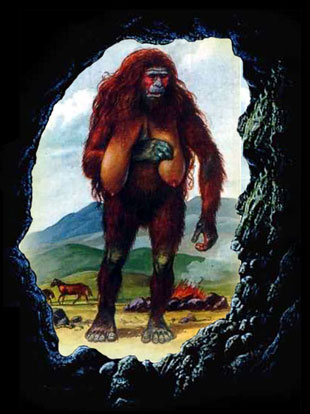
Adult Almases have been described as being at least 5 ft tall, shy, hairy, with broad feet and splayed toes, humanlike hands with long fingers, prominent eyebrow ridges, slanting forehead, nose very flat, a receding chin and a jaw that protrudes out. Their diet allegedly consists of small mammals and wild plants.
Some of the other names by which these creatures are known, depending on the particular region, are 'Wind-Man', Abnuaaya, Barmanu, Bekk-Bok, Biabin-Guli, Gul-Biavan, Guli-Avan, Golub-Yavan, Kaptar, Kra-Dhan, Ksy-Giik or Ksy Gyik, Mirygdy, Mulen, Voita, and Zagitmegen.
Almas Timeline:
1420 — The first known printed reference on the Almas was made by a Bavarian named Hans Schiltberger. He traveled through the Tien Shan mountains as a captive to the Mongols. During his imprisonment he kept a journal in which he wrote:
"In the mountains themselves live a wild people, who have nothing in common with other human beings, a pelt covers the entire body of these creatures. Only the hands and face are free of hair. They run around in the hills like animals and eat foliage and grass and whatever else they can find. The Lord of the Territory made Egidi a present of a couple of forest people, a man and a woman, together with three untamed horses the sizes of asses and all sorts of other animals which are not found in German lands and which I cannot therefore put a name to."
1807-1867 — Sightings reported at Khalkha, the Galbin Gobi and Dzakh Soudjin Gobi as well as in Inner Mongolia; also at the Gourban Bogdin Gobi, Chardzyn Gobi and the Alachan desert.
mid 1800s — A wild reddish-black hair covered woman with both mongoloid and negroid features, dark skin, broad body, large hands and feet and a sloped forehead, was allegedly captured in the western Caucausus region of Abkhazia, and given the name Zana or Zanya. According to accounts, she was very physically powerful, able to perform feats of exceptional strength. While in captivity, Zana was passed on through a succession of owners, including noblemen, and mothered several children (she was reputed to have a fondness for wine, which supposedly played a role in her pregnancies). According to the story, she had as many as 6 offspring, by different men. Of these, the first 2 perished, due to Zana washing them in cold water after birth. The other 4 survived with the help of the local village women, who took care of the children. They were fairly normal, except for being dark and physically powerful, and grew up accepted among the villagers. Each of these children reproduced and allegedly had descendants throughout the region, up to nowadays. Zana died sometime in the 1880s.
1881 — As almost to confirm Hans Schiltberger's journal, a Russian named Nicholai Przewalski rediscovered the horses the sizes of asses and called them, of course, the "Przewalski horses"; he also reported seeing 'wildmen' in Mongolia in 1871.
 | | | | |
| | |
| |
1906 — Badzar Baradiin, while on a caravan at the desert of Alashan, reports seeing an "hairy man standing on the top of a sand dune, outlined against the sunset." After being approached by the Imperial Russian Geographical Society's president and asked not to publish the incident, Badzar complies, but relays the information about his sighting to a personal friend, Mongolian professor Tsyben Zhamtsarano, who in turn begins a lengthy and determined investigation of the Almas.
1907-1940 — Professor Tsyben Zhamtsarano compiles eyewitness' accounts and recruits an artist to draw the likeness of the Almas based on the gathered descriptions. He also plots sightings locations and dates on a map of the region. After being imprisoned in Russia for a number of years, the professor dies in 1940. His files vanish, and are rumored confiscated by the authorities.
1910 — Russian zoologist V. A. Khaklov reports meeting a Kazakh herdsman who claimed that he had once observed a female Almas over a period of several weeks. She had been captured by some farmers and chained to a mill, he said, and was later set free. Her physical description contained nothing new, but Khaklov learned rare details of her behavior. According to the herdsman, the creature was usually quite silent, but she screeched and bared her teeth on being approached; she also had a peculiar way of lying down, or sleeping, squatting on her knees and elbows and resting her forehead on the ground with her hands folding over the back of her head. She would eat only raw meat, some vegetables and grain, and sometimes insects which she caught. When drinking water, she would lap in animal fashion, or sometimes dip her arm into the water and lick her fur.
| | |






 .
. .
.






 Change Your Life!