Athens
Greece's capital and largest city, Athens dominates its economic, cultural, and political life.
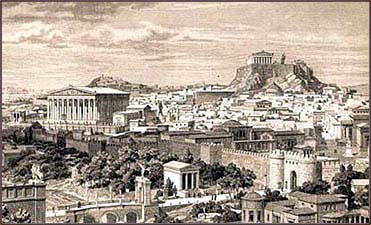
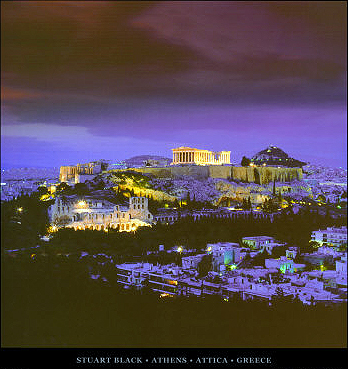
Athens is one of the oldest cities in the world, probably being inhabited for some six thousand years — the Acropolis of Athens has been peopled since Neolithic times and it may be the oldest continuously inhabited capital city in Europe.
With a recorded history of at least 3,000 years, as early as 1400 BC Athens was fortified in the manner of Mycenae, Tiryns, and other late Bronze Age citadels. At that time and in the subsequent 'dark age' (1200-900 BC) that followed the Dorian invasions, Athens was one of a number of petty states in Attica. In the mid-9th century BC, the surrounding territory, including the seaport of Piraeus, was incorporated into the city-state of Athens. Its cultural achievements laid the foundations of western civilization.
According to Greek mythology, when Athena and Poseidon disputed for the honor of being the city's patron, the goddess of wisdom produced an olive branch, the symbol of peace and prosperity, and the sea-god created a horse, symbolic of war. The gods deemed the olive the better boon, and the city was called Athens.
The birthplace of Socrates, Pericles, Sophocles and many other prominent philosophers, politicians and writers of the ancient world, early on Athens matured into a centre for the arts, learning and philosophy, and, in the first millennium BC, it became the leading city of Ancient Greece, even surpassing Sparta.
Today, the Greek capital is Europe's 8th largest city, with an urban population of 3.3 million and a metropolitan population of about 3.8 million people.
See Greece, Mystic Gifts and Charms - New Age Gift Shop & Wicca and Pagan Supplies, Love Spells -- Use these powerful love spells to help you find and keep your true love, The Tarot Store, The Chakra Store, Divination & Scrying Tools and Supplies, Unique Amulets, Talismans, Good Luck Charms, and Love Tokens, Powerful Witch Doctor Spell Kits, Powerful Spells - Cast by Andreika the Witch, Webmasters Make $$$, AzureGreen - Celebrating All Paths to the Divine, ISIS - Tools for Your Soul's Journey, and The Pyramid Collection - Myth, Magick, Fantasy and Romance.
Sources: (1) City of Athens official website; (2) An Online History of Athens.
| | |