A triangular-shaped island (area: 117 sq km or 45 sq mi) belonging to Chile, in the South Pacific Ocean, about 3700 km (about 2300 mi) west of the Chilean coast.
The island is formed of three extinct volcanoes. Swept by strong trade winds, the area is warm throughout the year. Indigenous vegetation consists mainly of grasses. Potatoes, sugarcane, taro roots, tobacco, and tropical fruits are grown in the fertile soil. The prime source of fresh water is the rain that gathers in the crater lakes. In 1722 several thousand Polynesians inhabited the island, but disease and raids by slave traders reduced the number to fewer than 200 by the late 19th century. Some intermarriage has taken place between the Polynesians and the Chileans.
The island was named by a Dutch explorer who landed here on Easter Day in 1722. The Chilean government annexed the island in 1888. An area on the western coast is reserved by the government for the indigenous population; the remainder is used as grazing land for sheep and cattle.
Easter Island is of considerable archaeological importance both as the richest site of the megaliths (see Megalithic Monuments) of the Pacific island groups and as the only source of evidence of a form of writing in Polynesia.
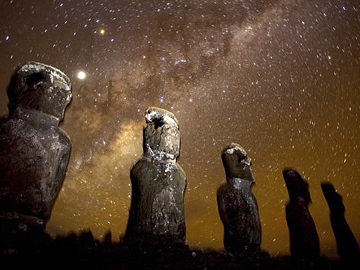
On Easter Island, Mysterious Statues Stand Beneath a Starry Sky, Easter Island, by Stephen Alvarez . . . - Buy this art print at AllPosters.com.
Very little is known about the people who made the megaliths and carved the wooden tablets. One belief is that settlement of Easter Island took place about 18 centuries ago, although some scholars contend that the settlement occurred more recently. Previous archaeological and botanical evidence suggested that the island's original inhabitants were of South American origin and that the ancestors of the present Polynesian population traveled in canoes from the Marquesas Islands, massacred the inhabitants, and made the island their home. Many archaeologists believed that at the time of the invasion the megaliths, including about 600 statues, were standing throughout the island and that many were destroyed by the Polynesians during a period of violence on Easter Island, but recent pollen and DNA studies point to a more ancient (30,000 years) Polynesian origin for the Island inhabitants.
Largest of the extant stone monuments are the great burial platforms, called ahus, which were used to support rows of statues. The ahus were situated on bluffs and in other positions commanding a view of the sea. Each ahu was constructed of neatly fitted stone blocks set without mortar. The burial platform usually supported 4 to 6 statues, although one ahu, known as Tongariki, carried 15 statues. Within many of the ahus, vaults house individual or group burials.
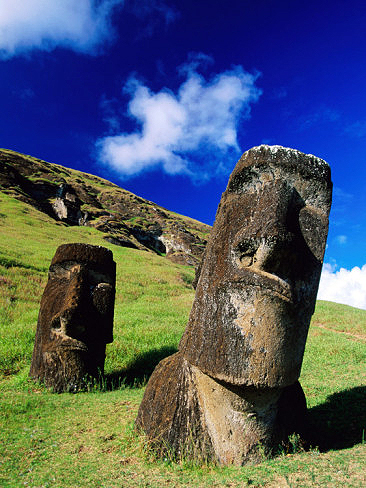
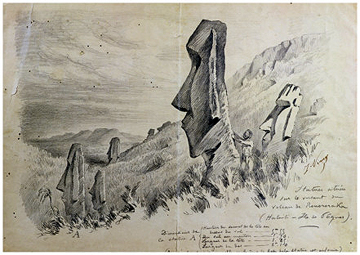
About 100 statues stand on the island nowadays (most have been re-erected by modern visitors); they vary in height from 3 to 12 m (10 to 40 ft). Carved from tuff, a soft volcanic rock, they consist of huge heads with elongated ears and noses. Material for the statues was quarried from the crater called Rano Raraku, where modern explorers found an immense unfinished statue, 21 m (68 ft) long. Many of the statues on the burial platforms bore cylindrical, brimmed crowns of red tuff; the largest crown weighs approximately 27 metric tons.
Excavations have also disclosed hidden caves containing decayed remains of tablets and wooden images, and numerous small wooden sculptures. The tablets are covered with finely carved and stylized figures, which seem to be a form of picture writing.
This website is best viewed with the latest
versions of
Microsoft
Internet Explorer or
Firefox.
Occultopedia
makes extensive use of
Flash and Scripting in its pages and interface. Make certain your browser
permissions are set
accordingly and that you have the latest
Flash plug-in for the full experience, proper look and accurate
layout. You can do it with confidence. This site does not contain any viruses, malicious software
or scripts.
Occultopedia is the genuine article, the
original and the best internet index of the extraordinary and uncanny,
shamelessly copied by many, but never equaled. Online since 1995 — at first in a free web space provider
(Tripod.com), and in 1997 finally
with its own domain name and hosting — Occultopedia still is the
principal online resource for those looking for the unexplained, the
curious and the unusual.
Occultopedia respects your privacy. As
such, no cookies or any other tracking software will be installed as a
part of this website's original programming. I do not seek to obtain any personal information
beyond what is volunteered through electronic communications
(e.g. emails & forms).
Occultopedia may appear to be a for profit site, but my site is
not in reality a commercial one. All of the commercial links are from affiliate
programs, and the little revenue I get from these is to pay for hosting,
bandwidth — that can be quite costly if you have a lot of traffic, graphics and
pages — and any other expenses related to Occultopedia's upkeep, support, and maintenance.
For more details, visit my
ordering
information page.
Occultopedia is a
FREE online
resource available to the whole world. Usage of my word definitions and articles
by educational institutions, teachers and students alike, is here by granted.
Reproduction for profit, and for display in another web site is strictly
forbidden, and will be handled as copyright infringement and prosecuted to the
full extent of the law. However, if you follow
some simple guidelines,
I will grant permission for limited reproduction. For more information, please consult my
intellectual property rights, warranties and
disclaimers information page. Support Occultopedia and make it your
online shopping
destination. If you prefer, you can also make a donation.
HELP FOOT THE BILL: this website
is created and maintained by one guy, who also pays the hosting bill.
Please donate if you like and/or use Occultopedia.
Participate in Occultopedia and submit a word
definition or article for the occult encyclopedia at my
entry submission
page. If you would like to suggest a web site or page for
addition into Occultopedia's links database, please go to my
URL submission page.







 .
. .
. .
.