Lynx Stone
Also known as 'Lyncurius', Lapis Lyncis, Lapis Lyncurius, Alpschos (Saxons) and Bilemites.
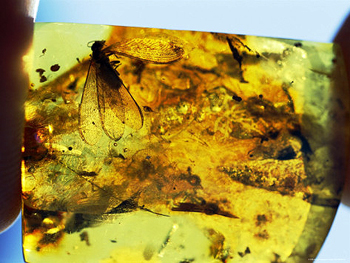
Ancient name for Amber, the fossilized resin of long-extinct pine trees that flourished from 40 to 60 million years ago. Inclusions, usually insects or pollen, are common; they were trapped in the viscous, sticky fluid as it oozed from the trees. Amber can be found in a variety of colors, ranging from clear to white, yellow, brown, and red.
The name of Lynx stone arose from the belief that amber was made of solidified lynx urine. Many myths associated amber with the sun, and immortality by extrapolation from the sun's perpetual rebirths. Some said the amber came from the apples of immortality in the Gardens of the Hesperides, brought by the sun hero Heracles. Ancient legends also tell that Amber was actually the tears of birds who were sisters of the Greek hero Meleager. In ancient Rome, Amber was used to ensure that children maintained good health.
The ancients prized the Lynx stone highly and attributed to it strange potencies against jaundice and other ailments. A volatile oil can be distilled from it and this oil was believed to be useful in treating infantile convulsions. When ground up with honey and rose oil and ingested, it was supposed to treat deafness, ear aches, and poor sight. Powdered amber, by itself or mixed with other substances, was also applied to burns, ulcers and carbuncles to aid in healing. Pliny, the elder, discredited not only its healing powers, but also its existence.
Other believed miraculous properties of the Lynx stone included healing wounds, soothing the lungs, repealing nightmares, and curing stomach ailments. The Lynx stone was also thought to be an effective protection against curses and spells, being widely used in the making of talismans and amulets. As a amulet, it has always been considered to be extremely lucky, providing protection against nightmares, witchcraft and the evil eye.
In Muslim nations, amber was valued as an incense, as well as a talisman. If Amber is rubbed vigorously, it develops a magnetic quality that enables it to lift objects. Because of this, the Greeks called it 'Electrum'.
According to Basilius Faber (Thesaurus, page 536), citing Andrea Cesalpino — the Italian physician, philosopher and botanist — and a number of other sources, the Lynx stone resulted from the urine of the lynx being deposited on the host (whether vegetable or mineral).
See Aetites, Talismans, Amulets, Radiesthesia, Lithomancy, Metaphysical Amulets and Talismans, Mystic Gifts and Charms - New Age Gift Shop & Wicca and Pagan Supplies, Love Spells -- Use these powerful love spells to help you find and keep your true love, The Tarot Store, Divination & Scrying Tools and Supplies, Unique Amulets, Talismans, Good Luck Charms, and Love Tokens, Powerful Witch Doctor Spell Kits, Powerful Spells - Cast by Andreika the Witch, Webmasters Make $$$, AzureGreen - Celebrating All Paths to the Divine, ISIS - Tools for Your Soul's Journey, and The Pyramid Collection - Myth, Magick, Fantasy and Romance.
 | | | | |
| | | |
| |
Sources: (1) Spence, Lewis, An Encyclopedia of Occultism, Carol Publishing Group; (2) Dictionary of the Occult, Caxton Publishing; (3) Bonner, Campbell, Studies in Magical Amulets, University of Michigan Press; (4) Budge, E. A. Wallis, Amulets and Talismans, Carol Publishing Corporation; (5) Walker, Barbara G., The Book of Sacred Stones: Fact and Fallacy in the Crystal World, Harper & Row; (6) Webster, Richard, The Encyclopedia of Superstitions, Llewellyn Publications.
| | |







 .
. .
.
 .
. .
. .
. .
. .
. .
.