Phantom Bus
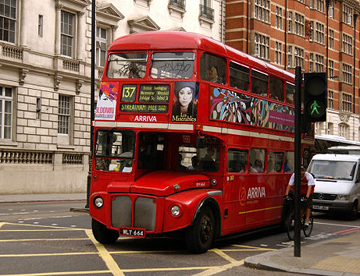
Allegedly a ghostly London bright red double-decker bus that, in the mid 1930's, made hundreds of appearances at the intersection of St. Marks Road and Cambridge Gardens, in North Kensington. The road curved sharply there, but it was nothing that the usually excellent London drivers couldn't handle.
According to most popular accounts, it first started in 1934, when a motorist who had crashed his car — but escaped unhurt — told police that he was making the turn when a bright red double-decker bus came hurtling toward him, forcing him off the road. The motorist also reported that the bus lights were on, but that he couldn't see a driver or any passengers.
The authorities set out to track down the offending bus, but were surprised to find that no buses were scheduled in the area at that time or anywhere near that time.
Then more accidents started happening, and again the story was the same — a red double-decker bus forcing the cars off the road. In every case, witnesses reported that the bus vanished right after it had caused the accidents.
Finally London officials straightened out the sharp curve, and there were no more accidents after that, nor was the phantom bus ever seen again. The tale is still told in the pubs of London today, sometimes a little differently, with the supposed death of the first motorist to have crashed after avoiding the phantom bus, as to add more flamboyancy and credibility to it.
See Ghost, Altered State of Consciousness, ESP, Seance, Materialization, Asport, Automatic Writing, Findhorn, Glastonbury Scripts, Theosophy, Poltergeist, Psychic Archaeology, Spiritualism, British Society for Psychical Research, Parapsychology, Nostradamus, Edgar Cayce, Mystic Gifts and Charms - New Age Gift Shop & Wicca and Pagan Supplies, Love Spells -- Use these powerful love spells to help you find and keep your true love, The Tarot Store, Divination & Scrying Tools and Supplies, Unique Amulets, Talismans, Good Luck Charms, and Love Tokens, Powerful Witch Doctor Spell Kits, Powerful Spells - Cast by Andreika the Witch, Webmasters Make $$$, AzureGreen - Celebrating All Paths to the Divine, ISIS - Tools for Your Soul's Journey, and The Pyramid Collection - Myth, Magick, Fantasy and Romance.
Sources: (1) Dictionary of the Occult, Caxton Publishing; (2) Spence, Lewis, An Encyclopedia of Occultism, Carol Publishing Group; (3) Shepard, Leslie A and Melton, J. Gordon (Editors), Encyclopedia of Occultism and Parapsychology, Gale Group.
| | |









 .
. .
.