Sphinx (Mythology)
A sphinx is a fabled monster. It has a human head and a lion's body. In ancient Egypt, where the idea originated, the head was usually a portrait of the reigning pharaoh. It also represented the sky-god Horus. The Egyptians always pictured their kings as calm and stately, with wide-open, staring eyes. The lion's body — symbolizing courage — is crouched with its front feet outstretched.
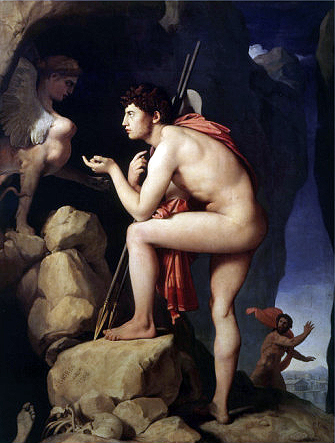
From Egypt the idea of the sphinx spread to the Syrians and Phoenicians and finally to the Greeks. These peoples gave the creature the head and bust of a woman. They added an eagle's wings to represent majesty and a long serpent's tail to indicate wiliness. In later Greek literature the sphinx was no monster, but a beautiful, wise, and mysterious woman.
According to a legend this monster put a riddle to all those who passed by and devoured those who failed to guess it. After many had died in this way, the Theban hero Oedipus answered the riddle correctly and so caused the monster's death.
See Zeus, Artemis, Hermes, Apollo, Delphi, Olympians, Greeks, Hera, Hades, Bacchus, Centaurs, Cerberus, Daedalus, Dionysus, Vulcan, Mars, Oracle, Tarpeian Rock, Tartarus, Telegonus, Telemachu, Mystic Gifts and Charms - New Age Gift Shop & Wicca and Pagan Supplies, Love Spells -- Use these powerful love spells to help you find and keep your true love, The Chakra Store, The Tarot Store, Divination & Scrying Tools and Supplies, Unique Amulets, Talismans, Good Luck Charms, and Love Tokens, Powerful Witch Doctor Spell Kits, Powerful Spells - Cast by Andreika the Witch, Webmasters Make $$$, AzureGreen - Celebrating All Paths to the Divine, ISIS - Tools for Your Soul's Journey, and The Pyramid Collection - Myth, Magick, Fantasy and Romance.
Sources: (1) Cooper, J.C. (Editor), Brewer's Book of Myth and Legend, Cassell Academic Publishing; (2) Evans, Bergen, Dictionary of Mythology, Dell Publishing Co., Inc.; (3) Dixon-Kennedy, Mike, Encyclopedia of Greco-Roman Mythology, ABC-Clio Inc. Publishers.
| | |



 .
.