Thor
Also spelled Thorr, Thunor, Thonar, Donar, Donner, Thur, Thunar, or Thunaer.
In Norse mythology, the god of thunder and the sky.
Thor was the eldest son of the chief deity, Odin, and Jorth. He was second only to Odin in importance and was probably the most popular god of the Norse pantheon.
Thor had three principal possessions, a hammer (Mjöllnir), typifying thunder and lightning and having the virtue of returning to him after it was thrown, a belt (Meginjardir), which doubled his strength, and iron gloves to aid him in throwing his hammer.
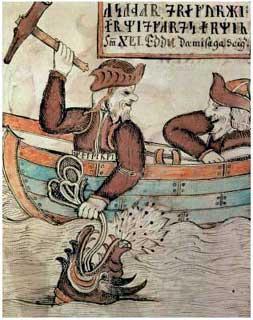
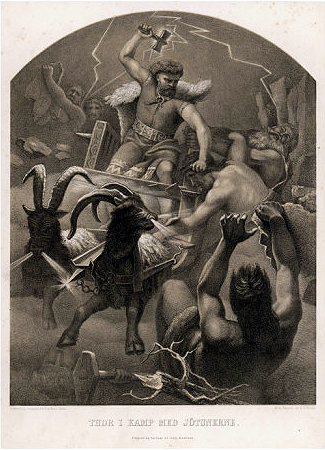
Thor specialized in killing giants and was forever at war with them. Virtually all of Thor’s myths have to do with giantslaying. He slays the strongest giant, Hrungnir, in a duel. He kills Geirröd, and more famously Geirröd’s daughters, on a visit to that giant. He kills Thrym, and all the giants in his family, when he goes off to Thrym in the guise of Freyja, supposedly to be given to Thrym in exchange for Thor’s stolen hammer. He kills Hymir and a host of giants when he goes off to Hymir’s home in Giantland to acquire from him a huge kettle in which the gods will brew beer. He kills the giant who built the wall around Ásgard. His greatest struggle was with the Midgard serpent, the most powerful giant of all, whom he fished up out of the deep sea.
Thursday, the fifth day of the week, was named for Thor; the name is believed to be derived from Jupiter Tanarus, the Thundering Jupiter, a Celtic deity.
See Odin, Vikings, Mystic Gifts and Charms - New Age Gift Shop & Wicca and Pagan Supplies, Love Spells -- Use these powerful love spells to help you find and keep your true love, The Chakra Store, The Tarot Store, Divination & Scrying Tools and Supplies, Unique Amulets, Talismans, Good Luck Charms, and Love Tokens, Powerful Witch Doctor Spell Kits, Powerful Spells - Cast by Andreika the Witch, Webmasters Make $$$, AzureGreen - Celebrating All Paths to the Divine, ISIS - Tools for Your Soul's Journey, and The Pyramid Collection - Myth, Magick, Fantasy and Romance.
Sources: (1) Daly, Kathleen N., and Rangail, Marian, Norse Mythology A to Z, Facts on File Publishing; (2) Evans, Bergen, Dictionary of Mythology, Dell Publishing Co., Inc.; (3) Lindow, John, Norse Mythology: A Guide to Gods, Heroes, Rituals, and Beliefs, Oxford University Press.
| | |