The fortress city of Homer's Iliad in the extreme northwest corner of Asia Minor overlooking the strait of the Dardanelles; also the land of Troy or the Troad, with Ilium as its chief city.
Ancient Troy was found near the western entrance to the Dardanelles, in modern Turkey, as described in the Iliad.
Troy was identified as early as 1801 by Edward Clarke, a British scientist. Later, during the 1850s and 1860s, Frank Calvert, U.S. consul at the Dardanelles, also convinced of this identification, probed the mound at Hissarlık and encouraged Heinrich Schliemann to commence extensive excavations. Schliemann’s fervor, personality, and discoveries (from 1871 to 1873 and 1878 to 1879) catapulted ancient Anatolia onto the international scene, leaving an indelible mark on the history of archaeology.
These excavations were continued by Wilhelm Dorpfeld, who discerned nine main periods of occupation at Troy (dating from Neolithic to Roman times), a sequence that was refined in the 1930s by Carl Blegen and his U.S. team.
Today the ruins of Troy are being reexamined by a joint German-U.S. expedition, led by Manfred Korfmann, that resumed work in 1988 (Korfmann and Mannsperger 1998). New information on the landscape around Troy over the millennia and the extent of the lower town at the foot of the citadel is that this ancient stronghold was a far larger, more important city than the archaeological record had previously revealed.
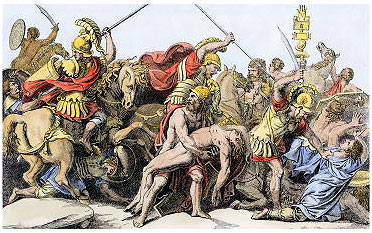
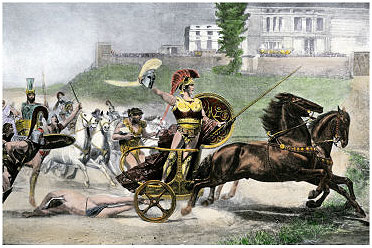
The tale of the siege of Troy is a conflict shrouded in mists of mystery and myth, but it is also the greatest secular story ever told. It has captured the imagination of the Western World for some 3,000 years, sprawling across cultures, time and geography.
This website is best viewed with the latest
versions of
Microsoft
Internet Explorer or
Firefox.
Occultopedia
makes extensive use of
Flash and Scripting in its pages and interface. Make certain your browser
permissions are set
accordingly and that you have the latest
Flash plug-in for the full experience, proper look and accurate
layout. You can do it with confidence. This site does not contain any viruses, malicious software
or scripts.
Occultopedia is the genuine article, the
original and the best internet index of the extraordinary and uncanny,
shamelessly copied by many, but never equaled. Online since 1995 — at first in a free web space provider
(Tripod.com), and in 1997 finally
with its own domain name and hosting — Occultopedia still is the
principal online resource for those looking for the unexplained, the
curious and the unusual.
Occultopedia respects your privacy. As
such, no cookies or any other tracking software will be installed as a
part of this website's original programming. I do not seek to obtain any personal information
beyond what is volunteered through electronic communications
(e.g. emails & forms).
Occultopedia may appear to be a for profit site, but my site is
not in reality a commercial one. All of the commercial links are from affiliate
programs, and the little revenue I get from these is to pay for hosting,
bandwidth — that can be quite costly if you have a lot of traffic, graphics and
pages — and any other expenses related to Occultopedia's upkeep, support, and maintenance.
For more details, visit my
ordering
information page.
Occultopedia is a
FREE online
resource available to the whole world. Usage of my word definitions and articles
by educational institutions, teachers and students alike, is here by granted.
Reproduction for profit, and for display in another web site is strictly
forbidden, and will be handled as copyright infringement and prosecuted to the
full extent of the law. However, if you follow
some simple guidelines,
I will grant permission for limited reproduction. For more information, please consult my
intellectual property rights, warranties and
disclaimers information page. Support Occultopedia and make it your
online shopping
destination. If you prefer, you can also make a donation.
HELP FOOT THE BILL: this website
is created and maintained by one guy, who also pays the hosting bill.
Please donate if you like and/or use Occultopedia.
Participate in Occultopedia and submit a word
definition or article for the occult encyclopedia at my
entry submission
page. If you would like to suggest a web site or page for
addition into Occultopedia's links database, please go to my
URL submission page.