Avalon
Alternatively Avalone and Avillion.
A Celtic name, possibly related to the Celtic king of the dead named Avalloc or Afallach, and traditionally interpreted in Welsh mythology as 'Island of Apples' — in Celtic mythology, the 'Island of Blessed Souls'.
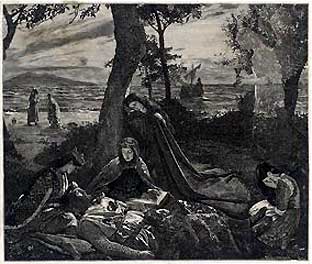
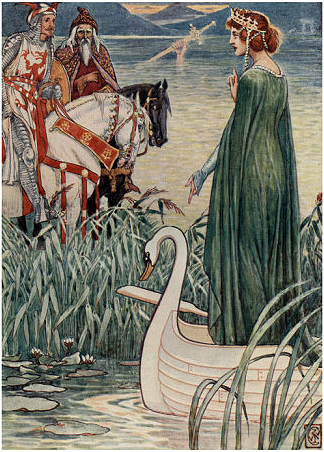
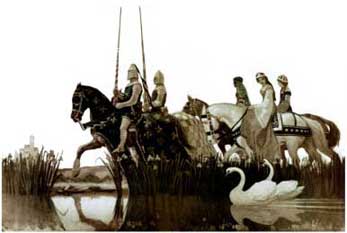
According to British legend, Avalon is the mythical land of immortal heroes wherein the enchanted sword Excalibur was forged and to where a mortally wounded King Arthur was taken on a boat by his half sister, Morgan le Fay, after a bloody battle in which he killed Mordred. According to some traditions, Arthur sleeps there merely to awaken at some future time.
There was a tradition that Glastonbury was the Isle of Avalon, and much of the area round Glastonbury was water-logged and marshy. In 1191, the monks of Glastonbury unearthed an oak coffin from 16 feet underground, which they claimed to be Arthur's. They showed an inscription, 'Here lies buried the renowned King Arthur with Guinevere his second wife in the Isle of Avalon', on a lead cross which they said had been found inside the coffin. Today, replicas of the cross are sold at Glastonbury Abbey.
Practitioners of Geomancy or 'earth divination' say that the subtle and elemental forces of the landscape in Glastonbury meet in a dynamic polarity that can create tension or harmony. Long term residents say Glastonbury is a place of conflict, a place of the shadow and the higher self — a place of heaven and hell.
Although the stories of Camelot, Arthur, and the Knights of the Round Table are probably only myths, there are actual sites on which Avalon may well have been based. Some sources suggest that Avalon lies off the coast of Great Britain or is possibly the island of Greenland. Others have considered Arran, an island off the coast of Scotland, as a possible model for Avalon.
See King Arthur, Glastonbury, Camelot, Lyonesse, Mystic Gifts and Charms - New Age Gift Shop & Wicca and Pagan Supplies, Love Spells -- Use these powerful love spells to help you find and keep your true love, The Chakra Store, The Tarot Store, Divination & Scrying Tools and Supplies, Unique Amulets, Talismans, Good Luck Charms, and Love Tokens, Powerful Witch Doctor Spell Kits, Powerful Spells - Cast by Andreika the Witch, Webmasters Make $$$, AzureGreen - Celebrating All Paths to the Divine, ISIS - Tools for Your Soul's Journey, and The Pyramid Collection - Myth, Magick, Fantasy and Romance.
Sources: (1) Spence, Lewis, An Encyclopedia of Occultism, Carol Publishing Group; (2) Lacy, Norris J., The New Arthurian Encyclopedia, Routledge Publishing; (3) Steiger, Brad and Sherry Hansen, The Gale Encyclopedia of the Unusual and Unexplained, Thomson Gale Publishing; (4) Coghlan, Ronan, The Illustrated Encyclopedia of Arthurian Legends, Houghton Mifflin Publishing.
| | |








 .
. .
.