Demonomancy
Alternatively known as Dæmonomancy and Demonancy.
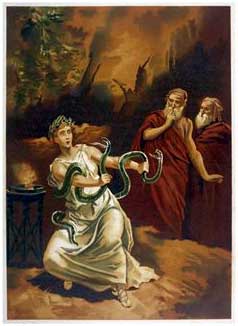
The art and practice of divining the past, the present and the future by the summoning and/or the aid of demons, devils and evil spirits.
It may be argued that all divinatory techniques are done with the aid of spirits, and that virtually all popular methods of foretelling the future work through the agency of certain demons. In the case of evil spirits and/or demons, the accuracy of any predictions made is thought to be unreliable, because of their wickedness and perversity.
In former times, it was widely believed that all divination was governed by demons. Contemporarily, most occultists insist that divination and crystal gazing are aided by spirits and/or deities.
Epilepsy, which in earlier times was often used for making predictions about the future, was widely regarded as a holy illness, in which the fortunate sufferer was used as a dwelling by the gods. However, Constantinus Africanus records that the general populace called epilepsy and insanity 'divinatio' (the divining art) and accounted for them as possession by demons.
In his An Encyclopedia of Occultism (1920) Lewis Spence wrote:
"Demonomancy: Divination by means of demons. This divination takes place by the oracles they make, or by the answers they give to those who evoke them."
Walter Brown Gibson, in his Complete Illustrated Book of Divination and Prophecy, said of Demonomancy:
"Divination through questions put to demons and the answers that they give. To do this, demons must first be evoked. This should not be difficult, if we accept the figures of medieval authorities, who claimed that exactly 1,758,064,176 lesser devils are constantly at large and ready to appear in some strange shape or form at anyone's mere wish. The problem is how to recognize demons when they do appear; and even then, how to know if their answers are correct, as they delight in deceiving those who summon them."
For centuries demons occupied a respected place as intermediary spirits between mortals and gods, but it all changed with the arrival of Christianity. Just as the Church converted old pagan horned gods of fertility into their Devil, so did it transform all demons into hideous creatures of evil, unclean spirits agents of Satan.
In ancient Greece, demons were considered to be inferior divinities, such as deified heroes, and generally were thought to posses beneficial natures. The word demon derived from the Greek daimon, meaning divine power, fate, or god. Many well-respected figures of early times, including the Greek philosopher Socrates, claimed to have been guided and protected by daimons.
Demonomancy was at times erroneously called Necyomancy (divination by the summoning, communication, and/or the aid of the dead) by some demonologists.
See Christianity, Genius, Genii, Jinn, Djin, Heptameron, Demonology, Sortilege, Radiesthesia, Astrology, Acutomancy, Agalmatomancy, Divination, Coscinomancy, Cleidomancy, Augur, Stoichomancy, Dowsing, Tarot, Idolomancy, Demonomancy, Tephramancy, Anemoscopy, Eromancy, Austromancy, Chaomancy, Roadomancy, Capnomancy, Pyromancy, Meteormancy, Ceraunoscopy, Zoomancy, Felidomancy, Horoscope, Horary Astrology, Zodiac, and Numerology.
See also Mystic Gifts and Charms - New Age Gift Shop & Wicca and Pagan Supplies, The Chakra Store, Love Spells -- Use these powerful love spells to help you find and keep your true love, The Tarot Store, Divination & Scrying Tools and Supplies, Unique Amulets, Talismans, Good Luck Charms, and Love Tokens, Powerful Witch Doctor Spell Kits, Powerful Spells - Cast by Andreika the Witch, Webmasters Make $$$, AzureGreen - Celebrating All Paths to the Divine, ISIS - Tools for Your Soul's Journey, and The Pyramid Collection - Myth, Magick, Fantasy and Romance.
Sources: (1) Spence, Lewis, An Encyclopedia of Occultism, Carol Publishing Group; (2) Dictionary of the Occult, Caxton Publishing; (3) Pickover, Clifford A., Dreaming the Future: The Fantastic Story of Prediction, Prometheus Books; (4) Dunwich, Gerina, A Wiccan's Guide to Prophecy and Divination, Carol Publishing Group; (5) Walker, Charles, The Encyclopedia of the Occult, Random House Value; (6) Gibson, Walter Brown, Complete Illustrated Book of Divination and Prophecy, Souvenir Press.
| | |






 .
. .
. .
. .
. .
. .
.