Grail, Holy
Alternatively Graal, or Holy Graal.
A certain vessel of alleged great sanctity, a symbolic talisman around which numerous medieval legends and poems revolve, which probably originated in Celtic pagan tradition as the cup of plenty and regeneration, symbol of the Great Mother.
The Grail is never mentioned in the Bible, but by medieval times it had been popularized as the holiest relic in Christendom, being associated with the cup used at the Last Supper, in which Joseph of Arimathea collected blood from Christ's wounds.
According to an ancient tradition, the Grail was carved from the emerald that fell from Lucifer's forehead at the time of his fall from heaven. Another legend held that the wearer of the Grail would be endowed with eternal youth.
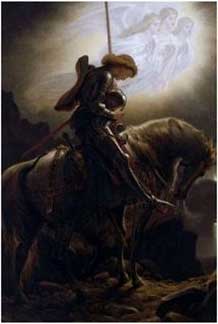
A portion of the Arthurian cycle of legends, the Grail was sought by the knights of King Arthur in several medieval romances, the earliest of which was the late 12th century Perceval by Chretien de Troyes. The quest for the Grail, which can only be found by a hero free from sin, is treated at length in the Morte d’Arthur (circa 1469) of Sir Thomas Malory and in Wolfram von Eschenbach's epic, Parzifal (circa 1210), which inspired the German composer Richard Wagner's opera Parsifal (1877-82).
In the traditions of many Christian sects, such as the Gnostics, Mary Magdalene was the wife of Jesus. In this interpretation of the events that occurred after Jesus’ death at the hands of the Romans, Mary brought the cup used at the Last Supper — the Holy Grail — from Palestine to southern France, where it would eventually be guarded by the Knights Templar. For those who hold such beliefs, the Holy Grail is but a metaphor for Mary Magdalene’s womb, which carried the true blood of Jesus in the person of his unborn child.
See Merlin, Templars, King Arthur, Glastonbury, Camelot, Lyonesse, Mystic Gifts and Charms - New Age Gift Shop & Wicca and Pagan Supplies, Love Spells -- Use these powerful love spells to help you find and keep your true love, The Tarot Store, Divination & Scrying Tools and Supplies, Unique Amulets, Talismans, Good Luck Charms, and Love Tokens, Powerful Witch Doctor Spell Kits, Powerful Spells - Cast by Andreika the Witch, Webmasters Make $$$, AzureGreen - Celebrating All Paths to the Divine, ISIS - Tools for Your Soul's Journey, and The Pyramid Collection - Myth, Magick, Fantasy and Romance.
Sources: (1) Spence, Lewis, An Encyclopedia of Occultism, Carol Publishing Group; (2) Lacy, Norris J., The New Arthurian Encyclopedia, Routledge Publishing; (3) Steiger, Brad and Sherry Hansen, The Gale Encyclopedia of the Unusual and Unexplained, Thomson Gale Publishing; (4) Coghlan, Ronan, The Illustrated Encyclopedia of Arthurian Legends, Houghton Mifflin Publishing.
| | |









 .
. .
.