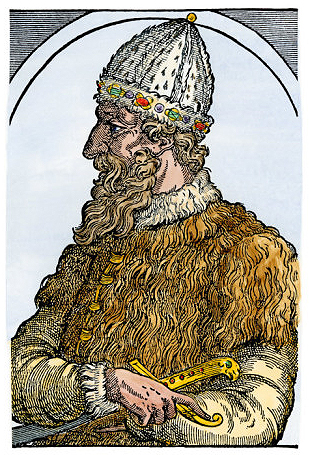
Jean, Ivan, or Iwan Basilowitz
The Grand Duke of Muscovy, or the Great, Grand Prince of Muscovy, in the 15th century.
Also surnamed the Great Czar of Muscovy, he was born in 1438, and succeeded his father Vasily Vasilievich, the grand duke of Moscow, in 1468.
Russia was then divided into a number of petty principalities, some of them nomally subject to the Czar, or Grand Duke; and tributary, together with himself, to the Mogul Tartas.
Iwan rendered the petty chiefs dependent on his own power, and emancipated himself from the yoke of the Moguls.
During his reign ambassadors arrived at Moscow from the emperor of Germany, the pope, the grand seignior, and most of the European powers. This prince, who is indeed considered as the founder of the Russian empire, died in 1505.
According to legend, when at the instant of death he fell into terrible black outs, during which his soul made arduous journeys.
In the first of these journeys, he was tortured for having kept innocent prisoners in his dungeons; in the second, he was tormented still more for having burden the people under heavy tasks; during the third voyage he died, but his body vanished mysteriously before he could be buried, and it was thought that Satan had taken him.
See Apollonius of Tyana, Alchemy, Archangels, Angels, Angelical Stone, Critomancy, Astrology, Acutomancy, Agalmatomancy, Divination, Coscinomancy, Cleidomancy, Augur, Stoichomancy, Dowsing, Tarot, Heptameron, Demonology, Sortilege, Idolomancy, Demonomancy, Tephramancy, Anemoscopy, Eromancy, Austromancy, Chaomancy, Roadomancy, Capnomancy, Pyromancy, Meteormancy, Ceraunoscopy, Zoomancy, Christianity, Satan, Mystic Gifts and Charms - New Age Gift Shop & Wicca and Pagan Supplies, Love Spells -- Use these powerful love spells to help you find and keep your true love, The Tarot Store, The Chakra Store, Divination & Scrying Tools and Supplies, Unique Amulets, Talismans, Good Luck Charms, and Love Tokens, Powerful Witch Doctor Spell Kits, Powerful Spells - Cast by Andreika the Witch, Webmasters Make $$$, AzureGreen - Celebrating All Paths to the Divine, ISIS - Tools for Your Soul's Journey, and The Pyramid Collection - Myth, Magick, Fantasy and Romance.
Sources: (1) Spence, Lewis, An Encyclopedia of Occultism, Carol Publishing Group; (2) Curtis, Thomas, A London Encyclopaedia or Universal Dictionary of Science, Nabu Press.
| | |