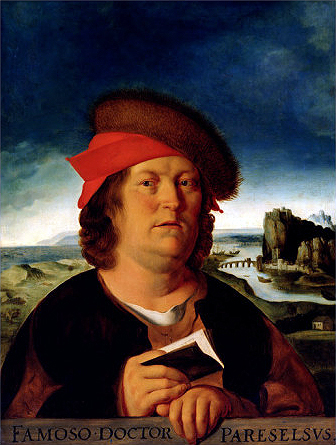
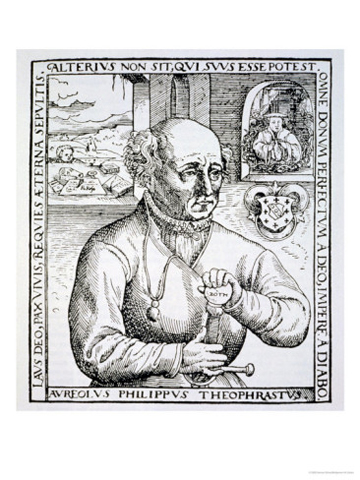
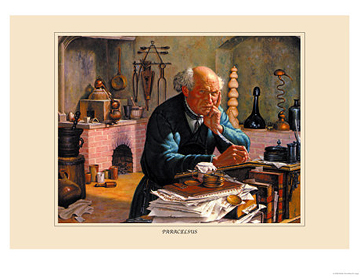
Paracelsus (1493-1541)
The name coined for himself by the German physician and alchemist Philippus Aureolus Theophrastus Bombastus von Hohenheim, who was born in Einsieden, Switzerland.
Paracelsus was a medical reformer who introduced a new concept of disease and the use of chemical medicines. He studied at several Italian universities and began to practice medicine and surgery in the 1520s.
A difficult personality, Paracelsus created controversy because of his wholesale condemnation of traditional science and medicine. He never obtained a secure academic position or permanent employment.
Paracelsus's new concept of disease emphasized its causes to be external agents that attack the body, contrary to the traditional idea of disease as an internal upset of the balance of the body's humors (yellow bile, black bile, blood and phlegm). Therapy, according to Paracelsus, was to be directed against these agents of disease, and for this he advocated the use of chemicals rather than herbs.
Alchemy became the means of preparing such chemicals; in this way Paracelsus changed the emphasis of the alchemical art from chasing the elusive Elixir of Life or Philosopher's Stone, to making medicines.
In his "Biographia Antiqua", Francis Barrett appends to the name of Paracelsus the following titles of distinction:
"The Prince of Physicians and Philosophers by Fire; Grand Paradoxical Physician; The Trismegistus of Switzerland; First Reformer of Chymical Philosophy; Adept in Alchymy, Cabala, and Magic; Nature’s Faithful Secretary; Master of the Elixir of Life and The Philosopher’s Stone, and the Great Monarch of Chymical Secrets."
See Paracelsus, His Mystical and Medical Philosophy, Paracelsus: Selected Writings, Paracelsus: Speculative Theory and the Crisis of the Early Reformation, Apollonius of Tyana, Alchemy, Archangels, Angels, Angelical Stone, Philosopher's Stone, Elixir of Life, Critomancy, Astrology, Acutomancy, Agalmatomancy, Divination, Coscinomancy, Cleidomancy, Augur, Stoichomancy, Dowsing, Tarot, Heptameron, Demonology, Sortilege, Idolomancy, Demonomancy, Tephramancy, Anemoscopy, Eromancy, Austromancy, Chaomancy, Roadomancy, Capnomancy, Pyromancy, Meteormancy, Ceraunoscopy, Zoomancy, Christianity, Satan, Mystic Gifts and Charms - New Age Gift Shop & Wicca and Pagan Supplies, Love Spells -- Use these powerful love spells to help you find and keep your true love, The Tarot Store, The Chakra Store, Divination & Scrying Tools and Supplies, Unique Amulets, Talismans, Good Luck Charms, and Love Tokens, Powerful Witch Doctor Spell Kits, Powerful Spells - Cast by Andreika the Witch, Webmasters Make $$$, AzureGreen - Celebrating All Paths to the Divine, ISIS - Tools for Your Soul's Journey, and The Pyramid Collection - Myth, Magick, Fantasy and Romance.
Sources: (1) Spence, Lewis, An Encyclopedia of Occultism, Carol Publishing Group.
| | |