Teraphim
Small idols or images of the ancient Hebrews and other Semitic peoples, worshipped by them as household gods or individual protecting deities (Judges 18:5, Hosea 3:4).
The word itself is of uncertain origin. A derivation from Hittite tarpi, meaning some sort of benevolent (or malevolent) spirit, has been proposed.
It was her father Laban’s teraphim that Rachel stole and hid in the camel’s saddle in Genesis 31:17-35. It seems likely that they were also used for divination and soothsaying (Ezekiel 21:21, Zechariah 10:2).
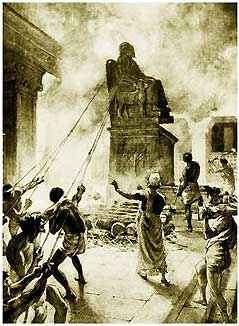
In ancient times, when temple priests were trained in the art of making automata, huge metal or stone statues were allegedly made to come to life for the purpose of making utterances about the future. The belief that spirits were capable of inhabiting statues was widespread, and it was thought that these idols could be made to reveal secrets of futurity by those who knew how to obtain it.
The ancients, specially the Hebrews, also believed that teraphim would talk to people, giving advice and making prognostications. These practices were often tolerated in early Israelite history, until they were finally outlawed in King Josiah's reform.
An old English folktale tells of a priest who brought the gargoyles of his church to life and they flew through the city at night so that no one could see them. City folk at first did not believe in the priest's tales and he was removed from the church. Later it was found out that many of his predictions, allegedly learned from the gargoyles, afterwards came true.
See Astrology, Acutomancy, Agalmatomancy, Divination, Coscinomancy, Cleidomancy, Augur, Stoichomancy, Dowsing, Tarot, Heptameron, Demonology, Sortilege, Demonomancy, Tephramancy, Anemoscopy, Eromancy, Austromancy, Chaomancy, Roadomancy, Capnomancy, Pyromancy, Meteormancy, Ceraunoscopy, Zoomancy, Mystic Gifts and Charms - New Age Gift Shop & Wicca and Pagan Supplies, Love Spells -- Use these powerful love spells to help you find and keep your true love, The Tarot Store, The Chakra Store, Divination & Scrying Tools and Supplies, Unique Amulets, Talismans, Good Luck Charms, and Love Tokens, Powerful Witch Doctor Spell Kits, Powerful Spells - Cast by Andreika the Witch, Webmasters Make $$$, AzureGreen - Celebrating All Paths to the Divine, ISIS - Tools for Your Soul's Journey, and The Pyramid Collection - Myth, Magick, Fantasy and Romance.
Sources: (1) Walker, Charles, The Encyclopedia of the Occult, Random House Value; (2) Jeffers, Ann, Magic and Divination in Ancient Palestine and Syria, Brill Academic Publishers.
| | |







 .
. .
. .
.